|
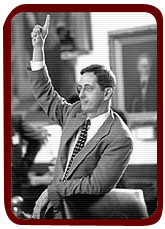 Jerry
Patterson was first elected to the Texas Senate in 1992.
Representing District 11, which includes Southeast
Harris County, Galveston County and a part of Brazoria
County, he played a major role in the enactment
of laws designed to increase the freedoms enjoyed by
all Texans and reduce the size of state government.
In 1995, Senator Patterson
was the author and tireless advocate behind the passage
of the Right-To-Carry law, which restored the fundamental
constitutional right of law-abiding Texans to carry
a concealed handgun. This legislation received nationwide
attention, leading to Senator Patterson's appearance
on several national news-related television programs,
including CBS News, Nightline and the Tom Snyder Show.
Approximately 250,000 Texans have exercised their constitutional
right and obtained a license to carry a concealed handgun.
Senator Patterson also passed legislation to increase
the penalties for parents who allow their children improper
access to firearms. He has been a strong supporter of
the "Eddie Eagle" program by the NRA which promotes
education regarding the responsible use of handguns.
Another major statewide
effort led by Senator Patterson was to allow Texans
the right to access their equity accrued in their home
for the purpose of securing a loan. Under Patterson's
leadership, the Home Equity Freedom Law was finally
enacted in the 75th Legislature, and the constitutional
amendment to give Texans this basic was approved overwhelmingly
in November 1997. Included on virtually every listing
of the top 5 major issues to be approved by the 75th
Legislature, the Home Equity Lending law represents
a substantial improvement in the ability of Texans to
manage their own finances without governmental interference.
Also in the 75th
legislature, another Patterson bill received nationwide
attention. His legislation to repeal the mandatory
motorcycle helmet law centered on a debate on whether
Texans can be responsible for their own safety. Effective
on September 1, 1997, the repeal of the helmet law returned
a basic personal right to thousands of motorcyclists,
and ended another burdensome example of unnecessary
governmental intervention.
Crime and criminal justice has also been
a prime focus for Senator Patterson. In his first session,
Senator Patterson took on the Resource Center, a state-funded
organization intent on using taxpayer money to fund
questionable deathrow appeals for convicted murderers.
As a result, the Resource Center was eventually ruled
unconstitutional and was shut down.
A member of the Senate
Criminal Justice Committee, Patterson also took a leading
role in the 75th Legislature on the issue of parole
reform. After holding numerous hearings with citizens
and law enforcement officials, Patterson introduced
a five-point plan to reform the state parole system.
The cornerstone of that package was the retroactive
repeal of the mandatory release program which allows
violent criminals back on to the streets well before
their full sentence is served. Supported by anti-crime
and victim's rights groups from across Texas, Patterson's
bill was deemed so important, it was granted emergency
status by Governor George W. Bush and passed from the
Senate only two weeks after the session opened. While
the bill encountered opposition and died in the House,
Patterson identified the problem and his leadership
framed the debate regarding the issue of early release
of felons. Included in his parole reform plan was legislation
designed to assist the state in apprehending the over
14,000 parolees who have become fugitives from justice.
With 2000 of these fugitives considered armed and dangerous
by law enforcement officials, the need for immediate
action was clear. In response, Patterson successfully
passed a bill which levies a fee on those convicted
of a felony which will pay for the apprehension of other
fugitive felons. His creation of the Fugitive Apprehension
Unit in the Department of Public Safety has led to the
capture and incarceration of many dangerous fugitives
from justice.
A member of the Senate
Economic Development Committee since 1995, Jerry Patterson
has also taken a leading role in the protection of small
businesses and consumers. In the 73rd and 74th legislatures,
Patterson played a major role in insurance reform legislation
designed to ease the insurance regulatory burden on
small businesses and individual Texans. In the 75th
session, he was the author and lead proponent of electricity
deregulation legislation which would have allowed real
competition in local electric utilities, and as a result,
lower costs to consumers. Like home equity and right-to-carry
reforms, Patterson's competitive electricity reforms
were considered one of the most important issues of
the 1997 session.
With Galveston and
portions of Brazoria County in District 11, Patterson
has made coastal management and protection issues
a center point of his service in the Senate. In 1993,
he established the Center for Texas Beaches and Shores
at Texas A&M University, a leading institution in
the study and protection of Texas coastal resources.
In 1995, Senator Patterson was co-author of the landmark
bill which called on the General Land Office to devise
a Texas Coastal Management Plan. This bill, and the
resulting plan, represents the most significant effort
to protect Texas beaches and coastal resources in recent
Texas history.
Finally, as a Vietnam
Veteran and a retired Lieutenant Colonel in the United
States Marine Corp Reserve, Jerry Patterson views veterans
issues as one of the state's highest priorities.
Chosen by Lieutenant Governor Bob Bullock as the first
chairman of the new Veteran Affairs and Military Installations
Committee in 1997, Patterson oversaw the passage of
landmark legislation related to veterans and military
installations.
Also in 1997, he was the author of what
most veterans organizations agree to be the most important
new veterans initiative in a quarter of a century. Senate
Bill 1060 by Patterson, established long-term nursing
facilities exclusively for Texas veterans at little
or no cost to taxpayers. These "veteran homes" will
be built by a state-federal matching program under the
authority of the General Land Office, and will be privately
operated without use of state Medicaid money. Hailed
as a legislative masterpiece, this bill gives veterans
a special benefit befitting of their honorable and courageous
service to their country and their state.
In his three sessions as State Senator
from District 11, Jerry Patterson enacted over 100
bills and taken a leadership role in countless others.
Yet the passage of legislation has been only part of
Patterson's work in the Texas Senate. He has worked
hard to give average Texans a voice in state government.
A voice calling for smaller government and greater personal
responsibility.
|